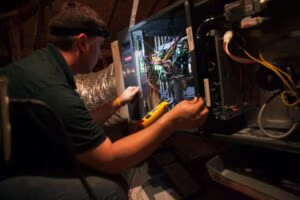
Why Is Warm Air Coming Out of My Vents?

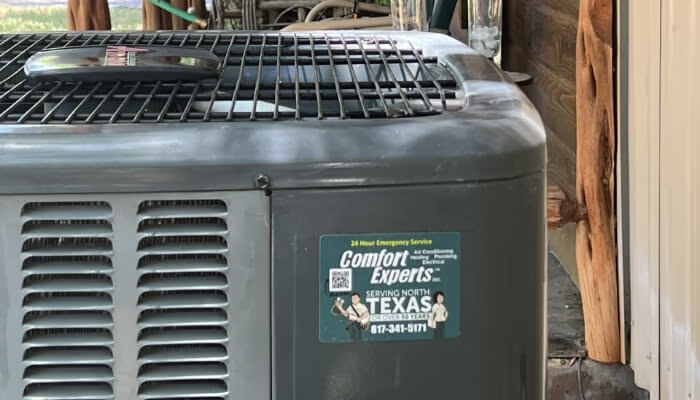
Close Up Hvac Unit With Sticker

Top Reasons Your AC Unit May Not Be Cooling Your Home

Let’s face it, we rely on our air conditioners to keep up feeling cool and content all summer long in Fort Worth.  And there’s nothing wrong with that.  But like every other appliance in the house, we run the risk of the air conditioner no longer working as it should.

So what do we do when we notice warm air coming out of the vents? If you are like most, you are not experienced with AC repairs and thus need to call on the expertise of professionals in order to have your AC unit fixed.

Comfort Experts AC repair technicians are professionals you can rely on to get the job done quickly and efficiently so you can get back to enjoying your summer. Before calling in the experts, here are some simple tips you can check to see why your AC unit is blowing warm air

Change the Air Filter

A dirty air filter will affect how well your AC unit runs during the summer.  The dirt from a dirty air filter will block the return airflow so that air doesn’t circulate properly throughout the house.  When this happens, it could cause your unit to freeze up.  In addition to the air filter, also check the outside unit to see if ice is forming on the unit.  If so, your AC unit may be functioning fine but all the cold air is being trapped inside the vents instead of coming through into the house.

It is important that you change your air filters on a regular basis, especially when your AC unit is in demand during the heat of summer.  Experts recommend changing the air filter at least once a month while using your AC all summer long.

Check the Thermostat Setting

Of course, this seems like an obvious solution, but double-check your thermostat to be sure it is set on the correct setting.  For example, make sure that the fan is set to “auto” and not “on”.  If your thermostat is set to “on”, it could be the cause of the warm air blowing out of the vents because the fan will continue to blow even when the air is not being cooled.  Keep the thermostat to “auto” so only cooled air blows out of the vents.

Look for a Refrigerant Leak

Refrigerant is important to cool the air the blows into the home as it absorbs heat from the air before it comes inside.  If your AC unit is low on refrigerant, it won’t work as it should.  Refrigerant isn’t used up as you run your AC unit, it is recycled instead.  So if you are low on refrigerant, it can only mean one thing: a leak.  If you notice refrigerator leaking from your AC unit call the AC repair experts at Comfort Experts to repair the leak and restore function to your AC.

When warm air is blowing out of your air vents, there could be a problem.  If you aren’t comfortable inspecting your AC unit on your own, turn to the AC repair pros at Comfort Experts to fix the air conditioning unit for a cool, relaxing summer.

What If My AC Unit Is Damaged From Flooding or Hail?

AC units are designed to withstand storms and weather as they are located outside the house.  In most cases, they are even able to withstand strong storms, including sleet and hail.  But sometimes, severe storms can cause damage.  For example, after a particularly torrential downpour, water may accumulate and pool around the AC unit. For those in hurricane areas, flooding may occur after a strong hurricane.  Standing water around the AC unit is cause for concern as it can significantly damage the moving parts or electrical components of the unit.

In most cases, water usually has to reach about a foot deep to affect the outside AC unit, but if you have experienced any flooding at all, it is recommended that you contact a professional AC repair company to come out and inspect your AC unit as soon as possible just to be safe.  In the meantime, here are some tips to follow if you have experienced flooding in your area and want to avoid further damage or potentially dangerous situations.

Slide3 768x380 1Cut Power to the AC Unit

First and foremost, to protect yourself and your AC unit, it is recommended that you turn off all power to the AC unit during times of heavy flooding.  Deactivate all the electrical controls of your unit.  If you are not comfortable turning off the electrical power to your AC unit on your own, then be sure to contact AC repair technicians to come out and do it for you.  Technicians are quick and efficient so that you don’t have to worry about something else happening to you or your home.

Remove Standing Water or Let Unit Dry Out

If possible, the best thing you can do for your AC unit is to get rid of the standing water around the unit after all power has been shut off.  Clear the debris away from the unit and give it time to fully dry out.  If you feel your AC unit is dry, it is still best to not turn on any electrical power until you have contacted expert AC technicians to come out and take a look.  Again, they can turn the AC unit on properly to avoid unwanted harm to both you and the unit.

Leave the AC Unit Off Until Inspected by a Professional

After severe water damage to an AC unit, it is not safe to turn it on again unless it has been thoroughly inspected by a professional AC technician with knowledge and experience to examine the unit, make repairs, and turn it on correctly.  Anytime you are dealing with electrical equipment, you want to be safe.  That is why it is best left up to the experts to turn your AC unit back on after a damaging storm.  AC repair technicians will fully inspect your equipment to make sure it is operating efficiently and effectively once again.

If you have suffered a storm and have flooding around your AC unit or suspect it may have been damaged in the storm, contact the professionals at Comfort Experts to repair your unit and get it up and running once again.

What Does My Attic Have to Do with Energy Efficiency?

Not many homeowners tend to make use of their attics.  They are dark and damp, freezing in the winter, and super hot in the summer. They are usually not insulated well, they aren’t heated or cooled, and they tend to have a lot of humidity and moisture no matter the weather outside. Even with the most effective and updated HVAC system in your home, your attic is likely to be a big energy waster, especially if it’s not properly insulated. Without effective and proper insulation, your attic can leak cool air in the summer and warm air in the winter, increasing your power bill and minimizing your in-home comfort.

Panel Group V4 Bg Scaled 1 1Here at Comfort Experts, we are not an insulation company, but we know how important it is to have your home properly insulated so that your HVAC unit can work the way it was intended while keeping your energy bills low. If you’re experiencing higher than normal energy bills or suspect issues with your attic insulation, we’d recommend that you look into getting that taken care of. Our AC repair technicians are amazing at what they do, but sometimes your issue may not be with your HVAC unit.

Attic insulation, along with ventilation, is key to your home’s energy efficiency.  The insulation keeps your home cool in the summer and warm in the winter.  That insulation also keeps the air from escaping out the attic.  If it somehow is escaping, it’s causing your system to work overtime to make up for that loss of temperature.  Having the proper attic insulation will reduce the wear and tear of your HVAC system and add years to its lifespan while also lowering your energy cost.

The Three Main Types of Insulation

There are a few types of attic insulation.  The least expensive is the roll-on or blanket insulation which comes in rolls of fiberglass batts that are designed to fit in between the framing of your home.  It is very flexible and easy to install.  This method keeps air trapped inside the house.

Blown insulation or loose-fill requires the use of a machine that shoots streams of cellulose over the framing. This insulation works well because it fills small crevices or hard-to-reach places.  This method is moisture resistant and can block mold and odors from forming inside your house.

Sprayed insulation, which has the highest rating, is usually the most expensive. This is the most energy-efficient option, however, and it usually lasts the longest.  This spray molds to the rafters block water vapors and almost completely stops air from going in and coming out.

Comfort Experts Has AC Repair Techs to Diagnose Your Problem

If you’re not certain what issue you’re having but know there is a problem, give us a call. We’ll come out and check out your HVAC unit and give you a diagnosis. If there isn’t an issue with your unit, we’ll tell you that too, and you can look into getting your attic insulation checked.

A Career in AC Repair: Is It for Me?

The HVAC industry is growing constantly and has ever-evolving technology, making it in constant need of hardworking men and women.  It is a very rewarding career path as you’re constantly helping your local community and, on top of that, it is a well-paying career.  As an HVAC company in North Texas, we get contacted frequently about what it takes to become an HVAC technician, and we wanted to let our friends and neighbors know a little about the career field and offer some information on the duties, requirements, and salary of HVAC technicians.

What Does It Mean To Be A HVAC Technician?Slide4 768x380 1

In general, the duties of an HVAC technician are to perform maintenance and service repairs on heating, ventilation, and air conditioning systems. Installing new units or replacing parts for existing units according to specs and established safety guidelines are a big part of the job too.  In most states, a technician is required to complete an apprenticeship and/or formal training in an area of specialty, as well as hold a high school diploma or its equivalent.  Many companies typically require 1-3 years of related experience, specified training, or a college degree.

An HVAC technician never runs out of work, as heating and air conditioning is a 365-day-a-year need, so job security is rarely an issue, even when there’s a downturn in the economy.  On average, you could expect to earn anywhere from $40k – $52k a year and a highly experienced technician can earn as much as $55 – $70k a year.  The ranges in salary are dependent on several factors including education, additional skills, extra certifications you’ve obtained, the area you live in, and the number of years’ experience you have.

How to Start a Career in HVAC

In the State of Texas, you can obtain a Class A or a Class B license in the field of heating, air conditioning, and refrigeration.  The Class A HVAC license allows you to work on any size unit, unlike Class B, which allows you to work on cooling systems that are 25 tons or under and a heating system of 1.5 million BTUs/hour and under.  Of course, like any license or certificate, classes must be taken and exams must be passed. There are several other requirements and prerequisites, like being at least 18 years of age and having a high school diploma or its equivalent.  For more information, you can contact the Texas Department of Licensing and Regulations.

Comfort Experts, Inc. is a 100% family-owned business.  We have a great team and love expanding by adding to our great family when needed.

If you want to utilize our services and have your HVAC unit serviced, checked, repaired, or replaced, get in contact with us at Comfort Experts, Inc.  We have been serving North Texas for over 50 years, and we are still just as passionate about HVAC as we were when we started. We look forward to serving you and your family for all your heating and AC repair needs.

Choosing the Best Thermostat for Your New System

When purchasing a new heating and air conditioning system, the one thing most people don’t think about is the thermostat.  The thermostat is an incredibly important component to your new system. It regulates the temperature in your house and can come in many different shapes and sizes, plain and simple, and smart and wireless.  With many options available today, it’s important to do some research and find a reputable company that can sell and install one for you.

How Does a Thermostat Work?

A thermostat measures the home’s ambient temperature and uses this information to activate your air conditioner or furnace, depending on the setting.  Some of the first thermostats used a float that was placed inside of a mercury thermometer and would rise and fall depending on the temperature, which would then cause the heat or air conditioning to turn on or off.

There really isn’t much difference in those thermostats compared to today, at least in the basic concept.  The principals are the same but the technology has improved quite a bit.  They still have some that run mechanically, but the modern ones all run electronically.  The “smart” thermostats are able to program themselves, and some can even heat your floors and cabinets, predict your temperature preferences, or switch between heating and cooling on their own.

Different Types of Thermostats

The basic thermostat is still pretty commonly in use.  Besides you switching it “on”, “off”, or to “auto,” the change in temperature is what essentially makes it turn on or off, much like a traditional light switch.  These standard or basic thermostats are trying to be phased out because of the mercury contained inside.

One favorite type is the programmable thermostat.  This thermostat will regulate on its own; once you set the digital program, the thermostat will regulate the temperature without you needing to do anything manually, making it very energy efficient.

There are also ones considered “learning thermostats.”  These can be programmed, but don’t actually require you to program them because the more you use them, the more they learn your habits and adjust to your preferences.  These types of thermostats are usually connected with WiFi and can often be monitored on your smartphone.  One unique feature of these new thermostats is what is called Geofencing.  This uses your location by your smartphone’s location to determine whether your unit should turn on or off.  You can set a range around your house and if you leave that range or come inside of it, then the unit will do a programmed function.  For example, when you leave for work and get outside of a 5-mile range of your house, then it can turn the heat off, and then it can turn it back on when you come back inside that range on your way home from work.

Where to Learn More

Today there are many options when installing a new heating and air conditioning system, including the ever-evolving thermostat.  For help in choosing the best product to meet your needs or any other heating and air conditioning questions, call the experts at Comfort Experts, Inc.  We have been proudly serving our neighbors in North Texas for over 50 years, and we’d love to serve you too!

How to Inspect an AC Unit When Flipping a House

Real estate investing is a large and lucrative industry, but you have to really do your homework and be careful who put your trust in. Chances are, you’re not an expert in every single facet of home flipping, so you need reliable advisers to help you make wise choices during your flip. One big area of concern is the condition of the central air and heating unit.  A unit is expensive and if you make the wrong decision about it, it can cost you thousands upfront and it can determine if you make a profit or a loss on a house.

Slide3 768x380 1When you’re selling a house, the HVAC system can make or break the deal. When you’re inspecting the HVAC unit and making a decision about repairing, replacing or leaving it there, the first thing you should do is look at the inside and outside units and check a number of things on each. Then, you should hire a professional, licensed company to inspect the entire unit.

The Exterior Unit

The exterior unit is probably where the inspector will begin.  They will check to see if the unit is clean, without any long grass, plants, or vines growing around it or with any other obstructions that will impact the operation and efficiency of the unit.  The exterior unit uses intake airflow to warm and cool the house, so anything in the way will disrupt the efficiency of the unit.

The coils are also an important part of the exterior as they can become dirty from debris, dust, dirt, and grass.  Sometimes nests from birds or insects can affect the performance if they are inside or around the unit. Luckily, these are minor issues that can easily be removed, but you should always have the technician take care of this issue.  Add some bonus points if the unit is on a concrete slab.  A concrete slab typically stays more leveled and elevates the compressor which keeps it a couple of inches above the grass, giving it better airflow and making it more efficient.

The Interior Unit

Usually when the exterior unit is cleaned and appears in good shape, then the system inside is turned on.  If you previously noticed that system wasn’t cooling well and now it is, then you know it just needed a good cleaning outside.  The air filter is another area you can easily check and fix if there are issues, though this is hardly a reason that will affect your decision to purchase a house or completely replace the AC unit. Even the thermostat is a quick fix if it’s less than ideal, but any major wiring issues or out-of-date equipment should be discussed with an AC professional.

The Investment

There’s a lot of risk in flipping houses.  Making sure you have an HVAC unit that is in good shape is crucial to making or breaking the deal, both for you and for a potential buyer.  When it comes to inspecting an HVAC unit, you must always hire an expert to do the inspection. For thorough and professional inspections or if you have any heating and air questions, call the HVAC professionals at Comfort Experts, Inc.

Address the Uneven Heating and Cooling Issues in Two Story Homes

How To Address Uneven Heating & Cooling Issues

Two-story houses usually have the problem of different temperatures between levels.  The upper level can easily be at least ten degrees hotter in summer, but when you turn down the AC, the lower level gets ice cold.  This can become a frustrating problem for many homeowners.

But what can be done to even out the temperature between the two levels?

Check for Proper Air FlowAC Repair Technician Outside

The first thing you can do is make sure airflow is coming through vents in order to heat and cool the home.  Blocked or closed vents may not be allowing airflow through, causing a temperature discrepancy upstairs that you don’t notice downstairs.  Move everything out of the way of the vents such as furniture, rugs, or drapes.  Both return and supply vents need to be free for air to come and go.  Blocking vents downstairs to avoid cooler temperatures on the lower level may seem like a good idea, but actually, all vents should remain unblocked on every level.  Switching the fan to the “on” position, even when the AC is on, will further help circulate air throughout the house.  It may raise your electric bill slightly, but not by much.  And it is definitely worth a little extra each month to be sure air flows evenly to all levels of the house.

Check for Leaky Ducts

If your ducts are leaking out cold air, especially in the air ducts that travel to the upstairs level, then not enough cold air is able to reach the second floor to cool it properly.  Many times, ducts lost about 20-30 percent of their airflow to gaps or cracks in ductwork.  Comfort Experts professional ac technicians can check for and repair any leaking ducts so that the maximum amount of cold air flow reaches every space.

Insulate the Attic

Insulation is designed to keep air in.  Therefore, proper insulation will keep warm air in during the winter to help heat the house, and it will keep cold air from escaping in the summer so that the house stays cooler all day long.  If you can see the floor joists in your attic, you are lacking proper insulation.  Consider installing adequate insulation maintain a comfortable temperature in your home year-round.

Install a Zoned System

One of the best things you can do to regulate the temperature both upstairs and downstairs in your house is to install a zoned system.  This system divided the home into two zones with two separate thermostats for each level.  Therefore, you can set the thermostat cooler at night when you go upstairs to sleep and warmer during the day when no one upstairs.  Alternatively, the downstairs can be set to cooler during the day when everyone hangs out on the lower level and higher at night when the family moves upstairs to sleep.  It’s the perfect solution for a two-story home.  To find out more about installing a zoned system in your house, call Comfort Experts, your ac repair, and installation specialists.

What You Need To Know About a Zoning System in Your Home

What Is a Zoning System?

A zoning system is an HVAC control that uses several sensors and thermostats to control the temperature in different locations throughout the home.  It is a dual-zone air conditioning system that operates when motorized dampers in the ductwork direct air to different parts of the home so that you can be comfortable no matter where you are in the house.

During the summer, larger homes will often be different temperatures in different parts of the home.  The upstairs tends to be much hotter than the lower story or the master may be warmer than the guest room.  If you have a room that you don’t use very often, it would also be nice to set it at a different temperature than the rest of the house and save money on energy costs.  If this describes your home, then it may be time to consider installing a zoning system.

Do You Need a Zoning System?

Zoning systems are often associated with larger, nice homes in wealthier areas, but they are for everyone.  A zoning system is great for families with many members who need different temperatures in their respective rooms to feel comfortable.  Also, those with several stories or more square footage to their home could greatly benefit from a zoning system.

An older unit will have a hard time keeping up with different levels or larger homes, but a zone air conditioning system allows you to adjust the temperature for each level or specific area of your home so that each ac unit can easily keep up with the airflow demands.   If you have a home office that you like cooler than the rest of the home, then a zoning system is a great solution.  Maybe you have bedrooms upstairs that you only use at night, but are always hotter than the rest of the house, then consider a zoning system.

You could adjust the temperature to be cooler at night and warmer during the day when the rooms aren’t in use, saving you energy and money. Technology is an added benefit for zoning systems as you can now control the temperature from your phone or computer if you aren’t home and want to save money on your energy bills by keeping the temperature higher while you are away.

Installation and Cost

Installing a zoning system is a relatively easy process as it can be installed new or to retrofit your existing system.  Dampeners will be installed in your ducts so that the zones can run off of one air conditioner and rely on the dampeners to redirect the airflow based on how you set your controls.  A zoning system has been shown to save homeowners roughly thirty percent on their energy bills, so it is definitely worth the cost.  Your new zoning system will likely pay for itself after only a few years.  For more information about cost and installation, contact an HVAC professional from Comfort Experts.

Paul Riddle Scholarship Recipient : Derek Hobby

Comfort Experts is proud to announce the newest recipient of the Paul Riddle Scholarship, Derek Hobby. Derek is currently an HVAC apprentice at Service City Air & Electric in Rowlett, Texas, and he will soon be attending our Perfect Technician Academy to become a certified HVAC technician. Perfect Technician Academy provides the HVAC industry with properly trained and well-educated individuals that companies love to hire. Each student completes an externship in their area of specialty so that they are more than prepared to enter the workforce upon completion of the Academy.

Van1web Albert EinsteinThe Paul Riddle Scholarship was created in honor of an influential leader in the HVAC industry. Paul had a servant’s heart and loved helping people improve themselves and change their lives, so it’s only fitting that the scholarship that bears his name allows people to learn how to become the perfect HVAC technician to both make a living and serve others in their community. We are excited to award the Paul Riddle Scholarship to Derek Hobby, and we are confident that he will make great strides in the HVAC industry both now and in the future
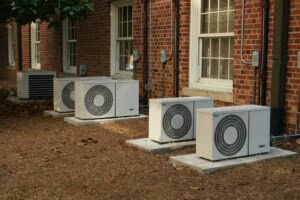
How to Know If Your AC Compressor Is Bad

The compressor is one of the most important parts of an air conditioning system.  The compressor’s job is to keep the refrigerant running and pressurize the system.  It is the part of the unit that cycles on and off continuously to cool the house.  Because of this continuous on and off-cycle, it can accrue significant wear and tear.  Be aware of the signs that your AC compressor may be failing so you can stay on top of a potential repair or replacement.

Strange Noises Coming From the UnitServices 762103 1920 1024x683 1

If you turn on your AC system and hear any type of loud, uncommon noise coming from the unit, it warrants a second look.  When a compressor first starts to go bad, the part will struggle to turn on.  This may result in strange noises.  Different issues with the compressor can produce different noises.  Loose bearings might make a grinding noise.  If a bearing is leaking, you might hear a squealing noise.  Any noise that isn’t normal might mean it’s time for a visit from the AC repair technician.

A Change in Air Flow or Temperature

When a compressor begins to go bad, the airflow output of the vents will begin to diminish.  If you notice the cold air coming out of your vents decreasing, call an AC repair company.  Another sign your compressor might not be working correctly is an increase in the temperature of the home.  Instead of blowing cold air, a bad compressor is no longer regulating the refrigerant flow, and so warm air comes out instead.  If you notice weakening airflow or warmer temperatures in the homes, your compressor may be failing.

Leaking Moisture

Leaks around an air conditioning unit are never a good thing.  Dirty or clogged coils can cause water leaks around the air conditioner.  However, a bad compressor can also leak refrigerant.  Refrigerant contains Freon and is not a substance that people should come into contact with.  It can cause health risks such as headaches, nausea, irritated eyes, cough, and more.  Because of the potential severity of coming into contact with refrigerant, if you see a leak and suspect it could be from the compressor, it is best to contact a qualified AC repair technician.  If the leaking isn’t dealt with, the compressor could run out of refrigerant, dry up, and stop working altogether.  Because a compressor is the main component in an air conditioning system, it can be costly to replace.  Any sign of possible wear and tear should be looked at as soon as possible.  When in doubt, call an AC repair professional to come to inspect your unit.  Knowing that you can have peace of mind that your family will be cool on a hot summer day is worth it.